Popular Posts

Sunday, February 19, 2012

How to support someone going through a divorce or break up

Divorce or a really bad break up can be classed as a trauma regardless of how much notice one is given. If we consider the things that help us feel secure in life, our jobs/homes/relationships/family and health are our core foundations.
Going through a divorce or break up, for whatever reason, can come as a shock – even if you knew it was coming. It’s a massive change and as human beings, we don’t take changes very well. Yes, there are opportunities which arise out of the change but first you need to process the feelings of rejection, grief, anxiety, panic, worry, loss of self esteem (as sometimes the rejection experienced is taken personally) and loss of ‘self’ as you probably linked your self-worth to your relationship.
In this blog, I am not going to handle divorce from the point of view of the person going through the divorce but from the point of view of the person who is supporting a partner or loved one through a divorce.
It may be that your partner, parent or close family friend has just told you they are getting divorced and you are watching them spiral slightly out of control.
Many feelings will arise including moodiness, upsetness, depression, anxiety, panic and insomnia. It is very hard to know how best to support someone through the roller coaster of emotions and if they are your close partner, you will almost feel like you are on the roller coaster with them.
It’s tempting to want to make them happy, distract them or tell them to stop being gloomy and feel different/ look on the bright side of life. A common human trait is to try to intellectualise the emotion:
“think of the opportunities”
“you never liked your ex anyway”
“there are lots of fish in the sea”
“God will never give you something you cannot handle”
“don’t be sad, this is a chance to really examine everything from a fresh perspective”
Although all these statements are probably true – it’s ALL about timing. Delivering these messages in the first few weeks is not going to go down well.
In the first few weeks, it’s critical for the ‘soon-to-be-divorced person’ to just feel their emotions. Emotions, when fully experienced, naturally evolve along the path of healing but its often the people supporting the person being made redundant that interrupt this healing pattern.
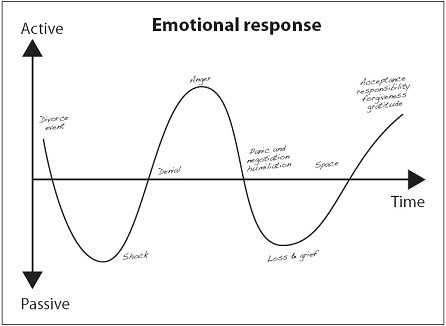
The initial state before the cycle begins is often quite stable, at least in terms of the
subsequent reaction to hearing the bad news (compared with the ups and downs to
come, even if there is some variation, this is indeed a fairly stable state).
And then, in the calm of this relative paradise, a bombshell bursts…

The naked divorce grieving cycle

1 Denial stage: trying to avoid the inevitable.
2 Anger and betrayal stage: frustrated outpouring of bottled-up emotion.
3 Panic and negotiation stage: seeking a way out. Making deals with your
ex.
4 Humiliation, fear of failure or looking bad stage: gradually sinking into
a spiral, feeling embarrassed and avoiding seeing people.
5 Despair stage: realization that something awful is coming your way and
you’re strapped into the rollercoaster and helpless.
6 Loss, grief and depression stage: a final realization of the inevitable,
surrendering to the grief.
7 Space and nothingness stage: once you have grieved and grieved, experiencing
loss and pain, you’re left with a feeling of nothingness. It’s different
to numbness because you feel very present and can notice things around you.
Your senses are heightened. You may also find that you cannot cry anymore.
You experience an emotional vacuum.
8 Acceptance stage: seeking realistic solutions and finally finding the way
forward, it’s not a feeling of resignation. It’s a feeling of profound understanding
of the way things are and the way things are not.
9 Responsibility and forgiveness stage: taking responsibility for where you
may have caused cracks in the relationship and contributed to its subsequent
breakdown and divorce. Forgiving your ex and yourself for any failings during
the relationship is a critical part of true and real healing.
10 Gratitude stage: transformational experience. Learning from your divorce
and seeing positives and negatives from the experience. This stage completes
the healing.

If your loved one wants to know where they are within the divorce healing cycle, take them to this test:  

FIND OUT HOW HUNG UP YOU ARE

What you don’t realise, in offering intellectual platitudes is that you are only doing this so YOU can feel happy again. It’s your own discomfort with their emotional state being so linked to your own emotional state that upsets you. If you resist their emotional state, it will persist because it has no avenue to be expressed.
So to survive and be happy in the first few weeks of supporting your partner, it helps to stop linking your own happiness to the happiness of this person – move to your own orbit and allow them to simply ‘BE’ where they are. Break your dependence on them and instead of fretting, go play tennis, go for a walk on your own or go shopping and allow them to be.
Here are a few tips of what to do and what not to do in supporting someone through this change.

Don’ts

  • Don’t give pep talks. Its not your job to pump them up and ensure they are happy again. Understand their need to express their emotions and use the BUCKET exercise below to give them an avenue to express these emotions Don’t intellectualise their emotions or offer any ‘sage’ advice – telling them to look on the bright side of life or telling them that ‘everything happens for a reason’ just invalidates the pit of despair they are looking into. Allow THEM to come to this conclusion on their own – this way, they will own the conclusion on a deeper level Don’t orbit around them or link your own happiness to their happiness – they are entitled to their process and way of dealing with things.
  • Don’t tell them to snap out of it
  • Don’t tell them they are being ridiculous, self indulgent or dramatic – use the BUCKET exercise to hear them – sometimes people just need to vent their emotions – its not necessarily about you.
    They will want to indulge in what I call STEATs (short term emotion avoidance tactics) so they can feel better and run from their emotions. They will want to avoid dealing with their emotions by focusing on decorating, shopping, partying, drinking or being super ‘busy’ with something or other. Rather than rejoice in these activities with them, encourage them to stop and feel their emotions. Validate their right to their emotions. If they engage in STEATs for too Long, they may end up depressed due to repressing their emotions
STEATs EXPLAINED
One thing to guard against is that your partner does not avoiding dealing with their emotions by burying themselves in things which either numb the pain or distract them. Don’t get me wrong, in the early days of divorce, the S.T.E.A.T.s are probably the things which help your partner feel better in each moment. BUT the thing to be aware of is that it’s not feeling better for real – it’s a false sense of security – a false feeling of recovering. It fits into the false healing category.
Short Term Emotion Avoidance Tactics include but are not limited to:
Excessive eating
Alcohol and drugs
Excessive anger towards others
Excessive socialising
Over-exercising
Fantasy or escapism activities (books, TV, movies)
Isolation
Random sexual encounters
Shopping/retail therapy
Spending countless hours with your children under the guise of being a good parent but the actual agenda is using your children to help you feel better
The problem with Short Term Emotion Avoidance Tactics is that they are short term. They do not last, and they do not deal with the true emotional issue. S.T.E.A.T.s are distractions that either damage or delay the recovery process.

Do’s

Once 45 days have passed, if they are still moping around – get them to see someone to process their feelings so that they can move on

BUCKET YOUR FRUSTRATIONS

    • Go fetch a bucket (a real one) and sit together with no TV or chaos in the background with the bucket between you both You start by encouraging your loved one to express their frustrations, feelings and emotions into the bucket – you not allowed to respond except to acknowledge that you hear what they are saying and ask if there is anything else to go into the bucket – encourage your partner to ‘put all their frustrations into the bucket’ and vent everything that is pissing them off about life and how life should be.
    • Your job is – JUST LISTEN
    • Keep asking if there is anything else and keep going until the bucket is full and they can think of nothing else
    • When done, you both pick up the bucket and throw out these frustrations out of the window or door
    • Now it’s your turn It’s good to say how you feel but I recommend not sharing your worries about their divorce – focus on other things that annoy you or frustrate you — this way, your loved one will feel they are not alone in being frustrated but they will feel that you are not pressuring them to snap out of their emotions
    • When done, you both pick up the bucket and throw out these frustrations out of the window or door
GRATITUDE
Now you both take turns to say what you are grateful for about your life. Your lives are actually very rich and amazing BUT because you dont focus on that, you dont see this. I want you to come up with at least 5 things you are grateful for
CREATE TOMORROW
Now you both take turns to say what you will accomplish tomorrow. This is important because at the moment, life is happening and things are not being created. Creation has a beauty to it
So, I hope that helps a bit. It is very challenging to go through a divorce, but even more challenging if you are the partner or close person of someone in that situation. If you have a specific situation you would like reviewed, contact the naked divorce team http://www.nakeddivorce.com/contact-us.

Till next time!


Sunday, February 5, 2012

BOOK - Naked Divorce for Women


How do you get over one of the most personal and devastating of life traumas and move on? How do you guarantee that you don't repeat the same mistakes, time after time and ENSURE you heal ethically from your divorce? 87% of people that don't 'process' their divorce, repeat the same mistakes in their next relationship. Introducing a revolutionary 21-day program which will not only get you back on track fast, it will actually help ensure you don't repeat the same mistakes in your next relationship. You will learn how to: strip away your old relationship baggage for good, learn to work with your emotions and not to fear them, deal powerfully with your family, friends and work colleagues, stop jealous and obsessive thoughts, hear the sorry you need to hear from your ex, avoid the biggest mistakes many people make within their career during divorce, tame your crazy emotions and re-establish emotional equilibrium, learn how to pave the way to finding the love of your life, use your divorce as the catalyst to become the woman you were always destined to be...

Available on Amazon: Purchase the BOOK here!

Sunday, January 15, 2012

The Ex-Factor – ex-etiquette, whether or not you have children!

Ex-Etiquette where there are no children involved

Divorce without children

If your divorce does not involve children from the marriage or the relationship, there is technically no reason to maintain contact with your ex. That’s the good and the bad news. The good news is that you won’t have to deal with your ex again. The bad news is that you have to acknowledge that it’s really over. Whether or not you remain friends with your ex is up to you. You don’t get extra points for an amicable relationship with your ex. The most important part of divorce is that it gives both parties an opportunity to move on with their new lives.
It’s easier to move on if you sever ties completely. Often an ex will maintain contact because they don’t want to move on.
Ending a relationship can be difficult, even when the relationship is painful. Some even prolong adversarial relations because it’s some form of contact.
Your ex may want to maintain in a friendly relationship. Sometimes this includes sex. Clearly they’re not moving on and there’s a possibility he can manipulate you into believing that there’s still ‘something there’ and a chance of getting back together.
Many people who try to stay friends after divorce are doing so in hopes of either rekindling the relationship or using the other person as a crutch until someone better comes along.
But what happens when it’s the other person who moves on first?

Being friends with your ex

Good for you if you can make the transition from ‘divorced’ to ‘friends’, especially if you have children and especially if you were married for a long time. But be sure that you’ve established your new, separate life before you make this transition. If you become best buddies too soon, your relationship with him could become a social crutch, or something you hide behind in place of creating a life for yourself.
The important point about being friends with your ex is that the relationship should evolve naturally. Don’t force it.
Also, it will not happen immediately – it cannot. You will need some time to ensure the relationship evolves into something clear where you can be friends.
In the beginning I recommend going cold turkey and not seeing your ex at all. Break all contact, delete him off Facebook and stop stalking him at the supermarket. Use the exercise on setting boundaries to set crucial boundaries with your ex.
When you have a new relationship you must honor your divorce. That means putting your new partner first. Any new relationship takes time to develop and you don’t want an ex hanging about in the wings to jeopardize things. You judge whether a natural friendship with your ex is healthy or not. If it interferes in your new life or your new relationship, end it.

Sex with your ex

Sometimes partners continue their sexual relationship after a break up. Sex relieves the loneliness and maintains ‘closeness’ with someone. Because you’re less familiar with each other after a break up, sex can feel more passionate. This is probably because it’s born of neediness and not love. Some couples will ‘use’ each other in this way while they’re breaking up. This prolongs the inevitable. I know of women who continue to sleep with their ex-partners long after they’ve remarried and had children. One such woman was Sue.
Sue continued to sleep with her ex-husband Ed on and off for 3 years even after Sue had remarried. It was very detrimental to both of them moving on or committing to their new relationships. When Sue’s new husband found out about her affair with her ex-husband, he ended their relationship immediately. Sue’s life became turmoil as she went through her second divorce within the space of a year.
This is not moving on. You need a clean break. You need closure. Don’t waste your life clinging to old relationships.
Women are often susceptible to sleeping with their ex during the Panic/negotiation phase of the naked divorce Grieving Cycle as a way of getting back together. For a woman, sex might mean all kinds of things and she’ll imbue it with all sorts of emotions. But it might not mean anything to the man.
  • Understand the phases you’ll go through after your divorce. Understand your hormones and those angst-ridden feelings and where they come from. The next time you feel compelled to contact your ex, ask yourself:
  • Do I miss being with him or do I simply miss being in a couple?
  • What if he says: “Let’s give it another go.” Will I be able to change what didn’t work the first time?
  • If you’re leaving the outcome of your relationship in his hands, ask yourself: What do I want? Is he the man I want to be with for the rest of my life, even if nothing changed?
  • How does being single make me feel?

If you are harboring resentment and anger towards your ex

Consider the impact of resentment and anger on your life. If you’re bitter and filled with resentment, remember that not forgiving someone is like taking the poison hoping your ex will die. You’re the one getting hurt by your bitterness. Your life is being ruined.
Complete the program, come to terms with your divorce, put it in the past and move on with your life as a different, more empowered woman.

If you simply can’t be friends

Be civil. When you bump into your ex, greet him, shake hands or hug him if you’re both comfortable with this, in same way you would greet a business associate.
If you’re paying child maintenance, alimony or spousal support, make sure you pay on time to eliminate any need for contact.

Ex-Etiquette where there are children involved

Don’t expose your children to marital conflict

When children are involved in divorce it’s very important for parents to behave civilly. I accept that this can be hard. It might always be hard. But there will be times you have to see your ex, perhaps when you communicate about the children’s health, school work and schedules, or during custody exchanges, or even sports, religious and academic events. In these cases, the rules are easy:
  • Be civil. Don’t speak badly of your ex in front of your children ever. Even though he’s your ex, he’s your child’s father and your child deserves to be able to love their dad without you poisoning the well. Whatever your relationship with your ex, always tell them their dad loves them. They need and deserve this.
  • Use tact. Don’t share details of your ex’s behavior with your children. Remember the oldest rule in the book: If you don’t have anything nice to say, don’t say anything at all.
  • Be nice. Don’t argue with your spouse in front of your children or on the phone. Be polite in your interactions. This not only sets a good example for your kids but can also encourage your ex to be gracious in response.
  • Look on the bright side. Choose to focus on the strengths of all family members. Encourage children to do the same.
  • Work on it. Make it a priority to develop an amicable relationship with your ex as soon as possible. Watching you being civil and caring towards one another will reassure your children and teach them a great life skill, too.
  • Make sure your marital settlement agreement (also known as a custody order or divorce agreement) spells out all details. While this sounds harsh, it helps avoid misunderstandings in the future. Honor your financial obligations and custody agreement, but wherever possible, work things out directly with your ex. Be flexible when you can be, and if you can’t, stick to the schedule the court assigns. If you don’t like the schedule, change it through the court system as a last resort, and with your ex. Don’t involve the children if at all possible.
  • Don’t give your children false hopes of their parents reuniting. This may mean putting some distance between the 2 of you. It’s more important for the children to accept the reality of their new life no matter how painful it may be. This way they can move on. The divorce affects them, too. If your children believe there’s a chance you may get back together, they’ll also be fretting about another break up.
If you find you’re always locked in a battle with your ex over the details of parenting, try to step back and remember the bigger purpose. It’s in your children’s best interests to have a lasting, good relationship with both parents. Keep your long-term goals in mind – your children’s physical and mental health and your independence – and avoid disagreements about daily details.

If your ex does push your buttons, think ahead before you see him.

  • What are the triggers?
  • How will you keep the peace and stay calm?
Your happiness and the happiness of your children and, yes, even your ex, should be the broad brushstrokes in the big picture of your new lives after divorce.
Working amicably with your ex after a separation or divorce is sometimes a tall order, but you have the power and insight to put your own feelings aside and do what’s best for your kids. Learn how to make the process of co-parenting easier on everyone.
Though divorce with children can appear more complicated, divorces without children can be equally complicated. There is the possibility of never seeing the person you once shared love and a life with ever again.
Till next time!

Sunday, January 8, 2012

Why therapy doesnt work and what you should do about it!


Now that I have stuffed myself full of mince pies and Christmas cheer – I think the time for jollyness has passed.
I am in that place called the CRIMBO LIMBO – that weird Bermuda triangle time between Christmas and new year. It’s a time of reflection and – dare I say it – a little ranting (she says with evil glint in her eye) at the ineffectual people who pass their advice over this holy period.
I feel it’s time for a little rant because I just read another winning article by a ‘renowned’ relationship psychologist in the Sun and then another prize-fighting article by Dr so-and-so in the Independent, who has been termed as ’a psychiatrist with 17 years of counselling and trauma experience’. You would think with all the letters behind their names that these two clowns know what they are talking about and that their advice should certainly be considered. Well people, I am utterly stunned that these individuals can get away with sharing these ‘sage’ tips or advice which endorse people to further intellectualise their emotions and engage in short term emotion-avoidance tactics whilst healing from their break up or divorce.
Take a line from one of these ‘experts’:
“whenever you are feeling low and upset after a divorce, forget the ex by going out with your friends on the town – wear a short little number and dance your cares away. Then when feeling low upon returning home, have a little treat – it’s better for you than a shot of whiskey”
OMG.
Are you frikking kidding me?
And this isn’t even the worst one. Dr so-and-so actually commented that Demi Moore deserved being dumped by Ashton Kutcher because she “should have known that marrying someone considerably younger was just full of trouble” and that “she should do something useful, like volunteer at a shelter or take up new hobbies to take her mind off things” as well as “giving it lots of time, as that is the ultimate healer”.
Oh and of course “Get a fresh make-up look and try out a new hairstyle signalling a new phase in  your life. Resolve to get out and about, proving there is a new life for you  and your children post break-up.”
Incredible.
Well Dr and Ms fancy-pants – if your profession was so good at sorting out people after their break up or divorce, then why is it that the 2nd, 3rd and 4th marriage divorce rates are exponentially getting worse on a global scale year-on-year? Only 14% of people married for a 3rd time have a chance at a happy ending. Your sage tips to ‘give it time’, ‘take your mind off things’ and ignore the issue by getting a ‘fresh make-up look’ is NOT HELPING the millions of people out there who are facing divorce every day.
Ok, rant over. Apologies for all the therapy-loving people out there. I think there is an important place for therapy and counselling in society but in my experience, many therapists have lost their way and become lazy or too focused on making money vs. actually helping people get over their break up or divorce.
Statistics show that people are not healing from their first divorce, so practically, people are carrying their weight in relationship baggage from one relationship to the next. Over the past ten years, this is a summary of the global marriage failure trend:


The average statistics across the USA, UK, Australian, South African, Canadian and New Zealand statistics over the past 12 years show that people are not healing from divorce leading to an increase in 2nd, 3rd and 4th marriage failures too.
Additionally, the Office of National Statistics in the UK and the USA Census Bureau has reported that over the past 10 years;
  • On average, over one third of marriages fail.
  • The most common age of divorced women is between 37 and 42.
  • At 49%, the USA has the highest divorce rate, followed closely by countries like the UK and Russia.
  • The average marriage lasts 11 years and in half of all divorces, there are children involved.
  • 50% of all divorced people say that they ‘felt there were things they could have done to prevent their divorce and they wish they had done more’.
  • 65% of people divorced for a 3rd or 4th time said that they wished they had handled their divorces in a more ethical and graceful way, taking a more active role in their healing. They also said that they wished they had gotten to the root cause of the break-up so that they didn’t ruin their next relationship.
Wow, now isn’t that fascinating :)
Ok, I know I am super sarcastic but it just infuriates me that good people are trusting the advice of these people and doing the best they can with this advice, only to find that they have not healed, have not gotten to the source of their divorce and are no further along the healing journey than when they started.
During the very early days of my divorce I took some action. I saw 2 therapists. This is what everyone said would be a good idea to do.
Both therapists told me that as I had been married for 7 years, it would probably take me at least 18 months – 2 years to get over the relationship and that I should ’take my time’.
The first therapist commenced the therapy session by taking me back to an incident from my youth. I was 2-years-old and was in hospital for many months due to a congenital hip birth defect. The doctors were spending months building me hip sockets and due to the strict rules of the hospital, my parents were not allowed to visit me very often. Consequently I developed some abandonment issues and rather than focus on the divorce, my therapist was linking my feelings related to the divorce to the fear I’d felt in childhood.
We explored that incident for some time and after 2 hours of deconstruction (and a hefty bill later), I left feeling thoroughly disempowered and confused. Not only had my husband ‘abandoned me’, my parents, doctors and family had abandoned me, and in turn, not only was I now annoyed with my former husband, I was now annoyed with the world too.
The parallel relevance of exploring the moment of abandonment in childhood and my husband leaving, although fascinating was not helping me get out of bed in the morning and deal with the issues right in front of me. I resolved that I did not want to spend months dissecting each aspect of my childhood in order to make sense of my divorce. I had very real issues to face in front of me right now. I wanted to talk about how I felt today and not about my life when I was 2-years-old. This process went on for a couple of weeks until I tried another therapist which was the same story.
Now, I know therapy works wonders for many people. I also know that it works very effectively in many situations and that millions of people all over the world choose therapy above any other process. Personally, it was very nice to have someone to talk to. I won’t knock that for a second.
I do, however, think that certain people do not have the patience for it and I count myself within this category. I wanted to get on with my healing. I wanted to take active steps and get to a place of empowerment again. I did not want to gaze longingly at my navel whilst I drifted back into my childhood.
I was seeking an alternative and in most cases, the clients who choose to work with me, have similar feelings.
My specific issues I had which then lead me to develop the naked divorce were:
  • I had no understanding of what I was going through and going to therapy didn’t give me any power in taking charge of my own healing. I felt dependent on my therapist.
  • It felt like we were going to do a great deal of analyzing during therapy and it was going to take an enormous amount of time. As human beings, we can tend to become fascinated by ourselves and our stories and I believe that taking great time to heal can be very destructive if we allow ourselves to become too self-indulgent. Renowned UK psychotherapist Nea Clark (http://www.balancedbusinessladies.com/) says “there is no need to indulge your feelings over a long period of time. Time doesn’t heal them. Better to do a program like the naked divorce and focus intensively on healing within a period of time. It’s healthier for your mind but also for your body”. Independent surveys conducted by the Stress Society of the United Kingdom have also shown that those who take a very proactive approach to healing, lead happier lives.
  • The healing process didn’t feel transparent, it felt like the therapists I saw had the secret to healing and the only way I was going to find out the secret was to commit to seeing them on a weekly basis for 18 months.
  • I felt that there was no goal or focus to my healing. The focus was rather on me fitting in whatever I needed to say within 1 hour. We would talk and I would say how I felt. This didn’t work for me.

  • My therapists were not experts in divorce. They were expert therapists and knew techniques for healing from all kinds of ailments. What I didn’t realize then and realize today is that divorce is a very specific set of circumstances and emotions and requires healing in a very specific way. Working with someone who didn’t specialize in those emotions and circumstances was not particularly useful.
  • My healing did not fit into the ‘let’s meet once a week for 1 hour’ structure. I required around-the-clock support with a phone call here, a text there, an email at 1 a.m. or a session with 1 day’s notice. I wanted a friend to walk with me through the process and not interact in a conventional way. Everything in my life was moving so fast that by the time my weekly session arrived, everything had changed and I spent the session catching my therapist up on my life VS actually making any real progress.

The REAL healing formula

I want to share a little secret with you – the real healing formula for divorce. I have worked on this particular theory with 67 people and this is what I found to work time-after-time:
Healing = SUM of 3 breakthroughs whilst keeping 3 critical factors in mind
That is it.
These 3 breakthroughs happen at any point and time plays no factor in these breakthroughs simply occuring. In fact, time plays no part in healing at all – it simply passes and waiting passively to heal whilst time passes, just wastes your life.
Healing is an active process and journey, requiring active engagement with the process. Basically stop stuffing around, waiting to heal – get busy with it and work on it.
The 3 breakthroughs are:
  1. Establishing a grounded routine so you can handle the transformation – in the naked divorce, this is called the Divorce Cocoon.
  2. Getting over your ex and processing your old relationship - in the naked divorce, this is called the Metamorphosis.
  3. Re-establishing your relationship with yourself redefining yourself, now that you are no longer married - in the naked divorce, this is called Release.
The 3 critical factors to keep in mind whilst healing is:
  1. Having a pressured environment — giving yourself a time restriction, combined with the pressure you naturally experience within your divorce creates perturbation which is an alteration or transformation which only occurs when you experience pressure whilst you have a cocoon or supportive environment with you. It’s the kind of breakthrough transformation that happens when you go through a near-death experience or life-threatening experience. These transformations are utterly life-changing and incredible. Divorce can be a catalyst for this kind of life-changing transformation, if you let it
  2. Having the right kind of support – in the naked divorce, we talk about interviewing someone to be your Divorce Angel. This person can be someone in your life – but it has got to be someone who will hold your hand as well as kick your butt. Criteria for choosing one is covered in my book
  3. Follow the critical habits for transformation – Stephen Covey created the 7 habits of highly effective people – WELL to heal, there are 7 habits for transformative healing. Ensuring you eat well, handle your emotions properly, behave appropriately at work, don’t engage in short term emotion avoidance tactics, have a good game plan and ultimately take daily action and focus intensively on your healing – then you will not only get over your divorce – people will NOT actually recognise you when you are over it.
Ultimately, stop listening to Dr so-and-so and these pathetic old-wives myths about healing and taking your time. They don’t work and causing families to be ripped apart. Take action. Get busy healing or get busy dying – the choice, I leave to you.
With love and a touch of Xmas cheer


Sunday, September 25, 2011

Why people drift apart when married…

Far from running from the idea of relationships during my divorce, I found myself fascinated by the dynamics of successful relationships. I wanted to learn everything I could about relationships and what makes them successful. This model from world-renowned life coach and self-help author Antony Robbins made an enormous difference to my life. Essentially, he moves through the cycles of how we communicate with each other in a romantic relationship and how, if we’re not vigilant, intimacy and love can break down. The 5 R’s are:
 Resistance
 Resentment
 Rejection
 Resignation
 Repression
Initially, you start out your married life with some kind of hope for a prosperous relationship. You’re in love, your partner is amazing and everything is perfect. One day, something happens. He says something unkind or does something that elicits resistance in you. You get that “Whoa! Hold on, that was not OK!” feeling. This initial resistance is a completely normal reaction to learning new things about your partner and also normal for any behavior he displays that is not OK with you. As women, we often assume that men will know when they’ve done or said something wrong. So we wait for them to acknowledge this by sulking or withdrawing into silence.
Some men are very perceptive and will know something’s up, others won’t have a clue that their behavior has made their partner unhappy. When we keep quiet about our resistance, the feeling can shift into resentment. Many people in unhealthy relationships simply avoid facing reality. Sometimes this can be because the people involved may be trying to make themselves appear superior. Or perhaps they don’t want to face the fact that their mates really aren’t who they say they are, or that they’ve fallen from the ‘perfect mate’ perch.
For example, Anne B covers up and makes excuses for her mate, Ben B, who is always late from work and almost always misses family functions. She might be trying to avoid the truth: that he’s a workaholic, or having an affair. She does so because she doesn’t want to destroy their ‘perfect couple’ image in everyone’s eyes – and perhaps even in her own eyes.
It’s like ignoring that broken handle on a door in your home or not replacing that light bulb. If you don’t address the resentment, other resistances and other resentments will begin to build up. Once there is some momentum with your resentment, then you or your partner may begin to experience rejection within the relationship.
Once rejection creeps into a relationship, it becomes overwhelming and makes it difficult to create or sustain an intimate sexual relationship. Those of us who have been married a long time know that once the relationship feels strained, the regularity of sex is affected, and things can spiral downhill very quickly. The bed becomes divided into ‘his’ and ‘hers’ zones and intimacy suffers. Even the smallest things he says or does are irritating and more resistance, resentment and rejection builds up. If you don’t discuss your feelings of rejection, then your relationship can shift into the place of resignation.
This is when you can so easily slip into co-habitation; operating as housemates or mere friends. Passion, love and chemistry, and all the elements needed to maintain the spark and fire within the relationship, exit through the window. You can end up with an amicable friendship.
This is dangerous! Contentment and harmony are wonderful hallmarks of a marriage, but be sure they’re not camouflaging deep resignation in a relationship. When left too long, resignation can lead to repression. We’ve all been out to dinner and watched the married couple opposite sitting in complete silence. They’re courteous to one another and exchange pleasantries, but perhaps they have succumbed to resignation or repression and no longer actively discuss their relationship.
Repression completely kills the passion and chemistry in a relationship. At this point you may begin to question your commitment to the relationship. You may wonder if your partner was ever right for you. You may begin to spend hours day-dreaming about escaping from the relationship. When we’re not claimed as women by our men in a relationship, we can become obsessed with romance and escapism, daydreaming about being rescued from the disappointing reality of life and marriage.
When you’re removed from the reality of your relationship and your life and escape into a fantasy world, then you’re in real danger of seeking fulfillment outside your relationship and marriage. This is fertile ground for cheating. This is when the ‘midlife crisis’ happens. This is when we start eating for comfort.
Because we didn’t communicate openly, vulnerably and humanly about all the little resentments, in the moment, they built up and killed the relationship.
Here is a video describing this in more detail:
So I here is an exercise which I want you to do together with your partner every day to defuse some of the stress you both have. Once you have de-stressed then start focusing on managing the 5 R’s in your relationship.
Every evening when you have put the kids to bed, I want you to do the following:
BUCKET YOUR FRUSTRATIONS
  • Go fetch a bucket (a real one) and sit together with no TV or chaos in the background with the bucket between you both
  • You start by vomitting your frustrations into the bucket – it’s not allowed to be aimed at him or aimed at fighting with him – he is not allowed to respond except to acknowledge that he hears what you are saying – aim it into the bucket and vent everything that is pissing you off about life, how life should be, what your finances should be like not like etc.
  • The job is – JUST LISTEN
  • He will ask if you are done – if not, keep going until the bucket is full and you can think of nothing else annoying you
  • THEN he will ask again if you are done, if you are – you both pick up the bucket and throw out these frustrations out of the window or door
  • Now it’s his turn
  • You also are not allowed to engage in conversation – he simply will vent his frustrations into this bucket – everything will go into it
  • You need to listen only and not argue or speak – just allow him to vent and encourage him to vent so he learns to speak more about how he feels about life
  • You will ask if he is done – if not, encourage him to keep going until the bucket is full and he can think of nothing else annoying him
  • THEN you will ask again if he is done, if he is – you both pick up the bucket and throw out these frustrations out of the window or door
GRATITUDE
Now you both take turns to say what you are grateful for about your life. Your lives are actually very rich and amazing BUT because you dont focus on that, you dont see this. I want you both to come up with at least 5 things you are grateful for
CREATE TOMORROW
Now you both take turns to say what you will accomplish tomorrow. This is important because at the moment, life is happening to both of you – neither of you say how you want your life to go or feel like you have any control over your lives. Examples include: I will finish the filing tomorrow, I will take a nap in the afternoon and find someone to take care of the kids etc. It will also be good for your husband to share with you more about his job.
The goal for the next week is to do this exercise daily. Once we have you both calmer and in a place where you can defuse the stress, we will move onto next steps!
Till next time!

Saturday, August 27, 2011

The naked divorce etiquette for handling your divorce at work if you are the boss!


  • If you are the boss going through a divorce, the key thing is appoint someone you trust to delegate responsibilities to.
  • Explain to this person that you are dealing with some personal issues at home (don’t get into specifics) and that you will require some extra support in the coming weeks.

  • When you delegate, be very specific about what outcomes need to be achieved. Have a discussion with this person or people about what you envisage and what the end game is and ask them to build plans for how those outcomes are to be achieved. Ask them to break the tasks down as much as possible, here is a suggested format:

  • Once everything is handled and you have a structure in place to achieve the outcomes laid out, take some time off to handle your personal situation.
  • If you have a very closely-knit team, share with them what is going on, but keep it brief. This is not the time to get the sympathy vote or try to get everyone to feel sorry for you. It’s important to remain powerful and grounded in their eyes. This will win their respect and devotion in more ways than one.
  • Even if you have close relationships with clients, I wouldn’t recommend telling them about your divorce. Simply mention you are taking some time off and their new contact person whilst you are away is XXX.
  • If necessary: Check in with your team whilst you are away to ensure that the delegation has worked successfully. This will give you peace of mind.
If you run your own company, then I strongly recommend you do the naked divorce program so you can get back on track as soon as possible. As you and I both know, there is no hiding behind emotions, you have to perform regardless of your emotional state – so get busy with your healing!

Lots of hugs

Tuesday, August 16, 2011

The naked divorce etiquette for handling your boss at work

Firstly, tell your boss what you’re dealing with. Do this in a brief and matter-of-fact way. Ask for a few days off. Deal with any urgent matters that won’t wait until your return to office. If you think you might get overly emotional, write a formal email or letter.

THEN…

  • Communicate very clearly with your boss about what he or she can and can’t count on from you. Give deadlines and try your best to stick to them. However, if it looks like you are struggling to meet a deadline, communicate with your boss immediately and recommit to what is possible.
  • Watch your work hours. Your colleagues and boss will be looking to see if you are working less hours, therefore, unless you have permission to work less, work the full allotted time you are hired to work. If you arrive late, communicate immediately that you are going to be late AND ensure you work later to make up the time.
  • If you are taking time off and have close relationships with clients, I wouldn’t recommend telling them about your divorce. Simply mention you are taking some time off and their contact person whilst you are away is [insert name.]
  • If you have the option to work from home, do so. It’s easier to maintain professional etiquette via email and remotely than to be around the colleagues and people you work with every day when you’re dealing with raw emotions.
  • Inform the accounts department as soon as possible about your pending divorce as your tax code may change. If you feel nervous about calling and aren’t feeling organized, prepare a list of things to communicate and email this through. Ensure that you include your current tax code in the email.


Stay tuned for part III…
Lots of hugs!